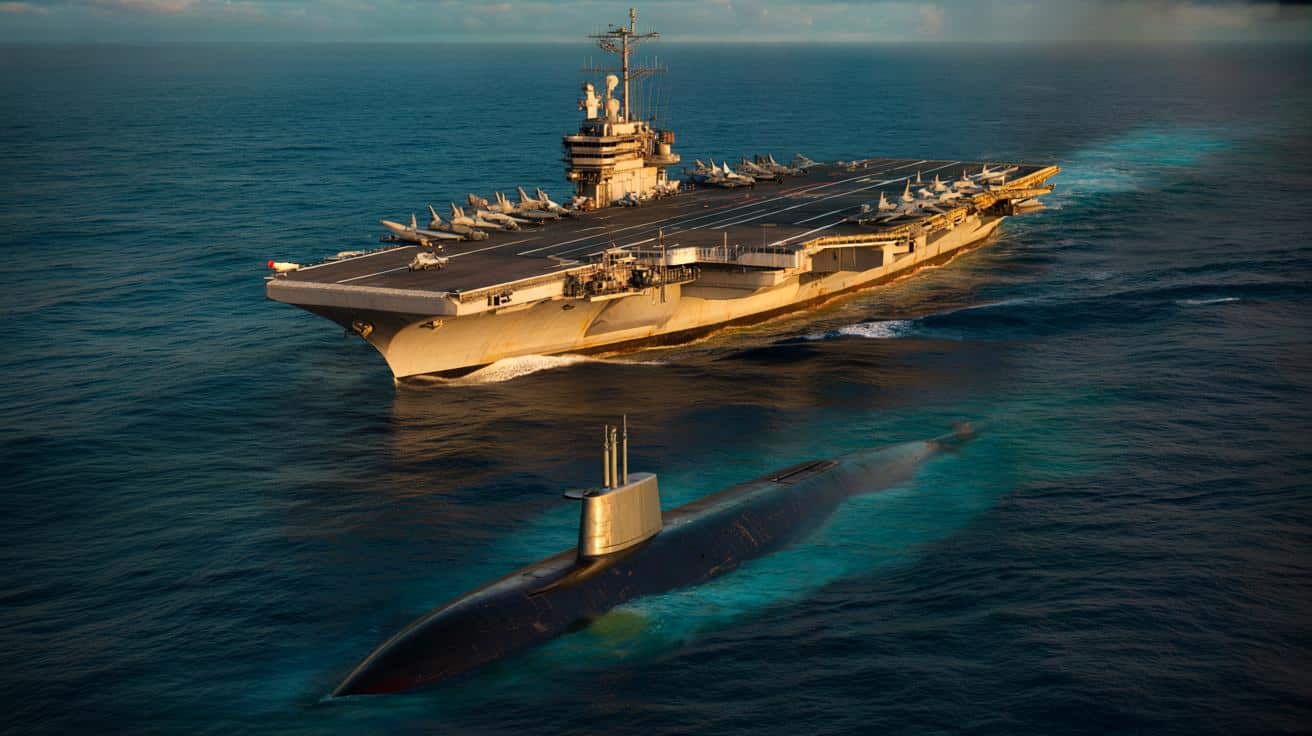
The admiral’s voice on the intercom was almost casual when he said the words nobody ever wants to hear on a $6,000,000,000 warship: “The carrier has been sunk.”
No alarms. No flames. No screaming sailors on deck.
Just a quiet room full of officers staring at a screen, stunned, as the replay of the simulation rolled again and again.
On the map, a single tiny symbol marked the intruder: a conventional diesel-electric submarine with an air-independent propulsion system, worth maybe $100,000,000 on a good day.
The kind of boat that doesn’t glow on radar, doesn’t thrum like a nuclear reactor, doesn’t look like the future.
Yet in this war game, it crept in, slipped under a billion-dollar shield of escorts and sensors, and “fired” a spread of torpedoes right into the heart of American naval pride.
Nobody in the room said it out loud, but the thought was there.
What if this had been real?
When a $100 million ghost humiliates a $6 billion giant
Picture a US Navy carrier strike group: a floating city of steel, jets screaming off the deck, helicopters circling, destroyers scanning the seas with radars and sonars.
On paper, it looks untouchable.
Yet for years, quiet diesel-electric submarines from friendly nations have been “killing” these giants in exercises the public barely hears about.
One of the most famous episodes dates back to the early 2000s, when a Swedish Gotland-class AIP submarine played the role of enemy in a US Navy war game.
The deal was simple: the sub would try to sneak up on the carrier group and attack.
It didn’t just sneak up once.
It did it repeatedly.
By the end of the deployment, the tiny Swedish boat had a photo album of periscope shots that no American admiral ever wants to see.
The lesson was brutal.
Take the Gotland-class as a symbol.
Roughly $100 million.
Air-independent propulsion that lets it run nearly silently for days without surfacing.
A crew that trains to turn that silence into a weapon.
In the exercise, the Gotland slipped beneath the thermal layers, using the ocean’s natural sound tricks as cover.
US destroyers pinged and listened.
Helos dangled dipping sonar.
P-3 Orions and P-8 Poseidons scoured the surface.
Yet the sub still got through, close enough for multiple “kills” on the carrier and its escorts.
No Hollywood drama.
Just a quiet operator watching sonars and current charts.
These weren’t accidents.
They were repeatable.
And once you grasp that, the $6,000,000,000 price tag on a carrier starts to feel less like dominance and more like a very big, very loud target.
On the face of it, the imbalance seems absurd: how can a platform that costs sixty times less threaten the centrepiece of US sea power?
The answer sits in physics, not politics.
➡️ Warum mentale Überlastung oft direkt nach dem Jahreswechsel entsteht
➡️ Vom Gehirn zur KI, das Wissenschaftsfest 2025 erforscht die Intelligenz(en)
➡️ Ein Luxushotel öffnete einem streunenden Hund die Türen und veränderte sein Leben
➡️ Warum agentische KIs kognitive Degradation-Risiken zählen und Simulations-Tests zu Hause zu laufen
➡️ Granatapfelkerne pulen ohne Sauerei: Mit diesem genialen Küchen-Trick klappt es in 60 Sekunden
Diesel-electric AIP submarines are built to disappear.
When they’re running on batteries and AIP modules, they’re whisper-quiet.
No reactor pumps, fewer moving parts, a smaller acoustic signature that gets lost in the background noise of the ocean.
Against that, even the best towed sonar arrays and ASW helicopters are fighting a stacked deck.
On top of that, the carrier’s job is visibility.
Launching jets, radiating radar, talking nonstop on secure networks.
It shines like a lighthouse in the electromagnetic spectrum.
The little sub just waits.
Patience vs presence.
In a confined sea like the Baltic, Mediterranean, or South China Sea, the math tilts hard in favour of the hunter.
How a cheap sub pulls off a billion-dollar ambush
If you strip the tactics down to the basics, an AIP sub’s playbook against a carrier is surprisingly simple.
It starts with one thing: getting into the right place early.
The sub slips out days before, heads toward a likely transit route, and then stops being active.
Engines off, AIP on, batteries topped.
It drifts.
It listens.
The crew stares at waterfall displays of sound, waiting for the unique acoustic “fingerprint” of a carrier group.
Once they hear it, they don’t rush.
They adjust course by fractions, use currents and layers, avoid predictable moves.
The art is to be exactly where the carrier will be, not where it is now.
When it works, the sub doesn’t chase the target.
The target walks right into its sights.
Most people imagine submarine hunting as a kind of underwater dogfight.
In reality, the deadliest diesel boats win by barely moving at all.
Here’s the emotional punch: we’ve all been there, that moment when the expensive, high-tech solution loses to the quiet kid who studied the map.
That’s essentially what happened when nations like Sweden, Chile, and even Germany brought their AIP subs to US-led exercises.
In one Pacific drill, a small conventional sub managed to slip under the defensive ring, park itself in the carrier’s path, and simulate a torpedo salvo at close range.
The escorting destroyers did everything right according to the manual.
Active sonar, airborne assets, layered defenses.
Yet they were looking for motion, noise, a clear threat.
The sub offered them almost nothing.
Just a faint blur at the edge of detectability.
By the time the group “saw” it, the scenario was already over.
Why does this keep happening?
Because the strengths and weaknesses of each platform are baked into their very design.
Carriers are about power projection.
They bring aircraft, logistics, command and control.
They’re huge because they must be.
That size limits where they can hide and how they can manoeuvre.
They’re excellent as long as they’re protected by an intact bubble of escorts and air cover.
AIP subs flip that logic.
They don’t project power across continents.
They project doubt.
A single quiet boat lurking near choke points forces an entire carrier group to slow down, zig-zag, launch more ASW patrols, and burn fuel and flight hours just to feel safe.
Let’s be honest: nobody really trains every single day as if a $100 million ghost is already waiting on the sea floor ahead of them.
Yet that’s exactly the mindset the new era of undersea warfare demands.
What the US Navy actually does after getting “sunk”
Behind closed doors, these humiliating exercise results don’t just vanish into classified archives.
They get turned into checklists, new drills, and awkward budget meetings on Capitol Hill.
One concrete response has been a renewed focus on anti-submarine warfare training.
More time for carrier groups hunting quiet diesel subs in complex coastal waters.
More foreign partners invited with their own AIP boats to act as realistic adversaries.
When a Swedish crew or a German crew keeps “killing” your carrier, you either learn from them or stay blind.
The Navy also tweaks its patterns.
Less predictability in transit routes.
More emphasis on multi-static sonar (multiple platforms pinging and listening in layers).
A push for unmanned surface and underwater vehicles to extend the listening perimeter.
It’s messy, incremental, not glamorous.
Yet that’s where survival lives.
Sailors quietly admit that one of the biggest dangers isn’t enemy genius.
It’s human complacency.
You sail for months without a contact, you run the same drills, and the ocean begins to feel empty.
That’s when shortcuts appear.
Templates replace thinking.
The sub threat becomes a checkbox instead of a constant presence in your head.
Then along comes a foreign AIP boat in an exercise and punches a hole right through the illusion.
The US Navy has started talking more openly about this “psychological warfare” of silence.
Recognizing that the real enemy isn’t just some future adversary’s submarine.
It’s the comfortable idea that the carrier group is always as safe as the glossy recruiting videos make it look.
*The ocean loves to punish overconfidence.*
“The lesson from every exercise where a diesel boat kills a carrier is the same,” a retired US anti-submarine warfare officer told me. “You don’t get to relax just because your ship costs billions. The ocean doesn’t care about your budget line.”
- Train with real quiet subs
Invite allied AIP submarines into major exercises and let them play full‑throttle adversary. That’s where the true weak spots show up. - Use unpredictable patterns
Vary routes, speeds, and formations so a patient sub can’t simply set up on your textbook track and wait. - Spread the ears of the fleet
Deploy more unmanned sonar platforms, more passive sensors, and more aircraft working together instead of a few ships trying to do everything. - Accept the “near invisible” threat
Design doctrine, not just hardware, around the idea that something you can barely hear may already be in firing position. - Debrief without ego
When a carrier gets “sunk” in a war game, treat it like a gift, not an embarrassment. Every fake torpedo now is one less surprise later.
The uncomfortable future of billion‑dollar targets
Once you’ve seen how a $100,000,000 diesel-AIP submarine can humiliate a $6,000,000,000 carrier on a quiet Tuesday in peacetime, it’s hard to unsee it.
You start noticing how much of modern strategy still leans on the psychological comfort of big, visible symbols: carriers, stealth jets, gleaming destroyers lined up at the pier.
Yet the real shift is happening in the shadows.
Smaller, cheaper, harder-to-detect systems multiplying beneath and above the surface.
AIP subs, long‑range anti-ship missiles, underwater drones, satellite tracking.
“Presence” doesn’t mean the same thing it did in the 1990s.
Being seen can be a weakness.
Being heard can be a liability.
Being predictable can be fatal.
Maybe that’s the quiet revolution these exercises are hinting at.
Not the end of carriers, but the end of assuming they can sail wherever they want, whenever they want, without a serious undersea chess match first.
Some readers will see that as a warning.
Others as a strange kind of reassurance, proof that no single navy gets to own the ocean forever.
Either way, the next time a carrier group appears in a glossy press photo, you might find yourself wondering about something that doesn’t show up in the frame at all: the little dot under the waves, waiting, listening, doing the math.
| Key point | Detail | Value for the reader |
|---|---|---|
| Asymmetry of cost | $100M AIP subs can threaten $6B carriers in realistic exercises | Shows how smaller powers can challenge even the mightiest fleets |
| Power of silence | Diesel-AIP boats exploit quiet running and ocean physics to evade detection | Helps readers grasp why “low-tech” platforms can beat high-tech giants |
| Shift in naval doctrine | US Navy adapting with more ASW training, allied subs, and new sensors | Offers context on how future sea wars might actually unfold |
FAQ:
- Question 1
Can a conventional diesel-AIP submarine really sink a US aircraft carrier in wartime, not just in exercises?
In theory, yes; in practice, it would be extremely hard. Exercises remove some variables like full wartime rules, electronic warfare, and live weapons. Still, the fact that AIP subs consistently “kill” carriers in drills shows the threat is real enough that no admiral can ignore it.- Question 2
Why doesn’t the US simply build more diesel-AIP submarines itself?
The US Navy’s global mission leans on nuclear submarines, which can sprint and stay submerged for months across entire oceans. Diesel-AIP boats shine closer to home waters and in choke points. Washington has chosen reach over local stealth, while allies like Sweden, Germany, and Japan fill the diesel-AIP niche.- Question 3
Are aircraft carriers becoming obsolete because of cheap submarines and missiles?
Not obsolete yet, but more vulnerable and more limited. Carriers still offer unmatched airpower far from land, especially in lower‑intensity conflicts. Against a peer adversary with strong submarines and missiles, though, their operating areas shrink, and they need far heavier protection and smarter tactics.- Question 4
What exactly does “air-independent propulsion” mean on a submarine?
AIP systems let a non‑nuclear sub generate power underwater without surfacing for air as often. That can be Stirling engines, fuel cells, or other tech. The result is longer, quieter submerged endurance, turning the boat into a much harder target for traditional anti‑submarine warfare tools.- Question 5
Have any US carriers ever been attacked by a real enemy submarine in combat?
Since World War II, no US carrier has been sunk or badly damaged by enemy subs in battle. The modern concern isn’t based on recent combat losses but on classified simulations, Cold War cat‑and‑mouse games, and these publicized exercise “kills” that hint at what could happen if things ever turned hot.